
Guide number 06Advent guides6 min read
History of the Advent Calendar: From Chalk Marks to Chocolate
Where the Advent calendar came from: chalk marks in 19th century Germany, Gerhard Lang's printed calendars, doors, chocolate, war and its spread to America.
We may earn a commission when you buy through links on this page. Listings and prices come from our partners and change often. How we make money.
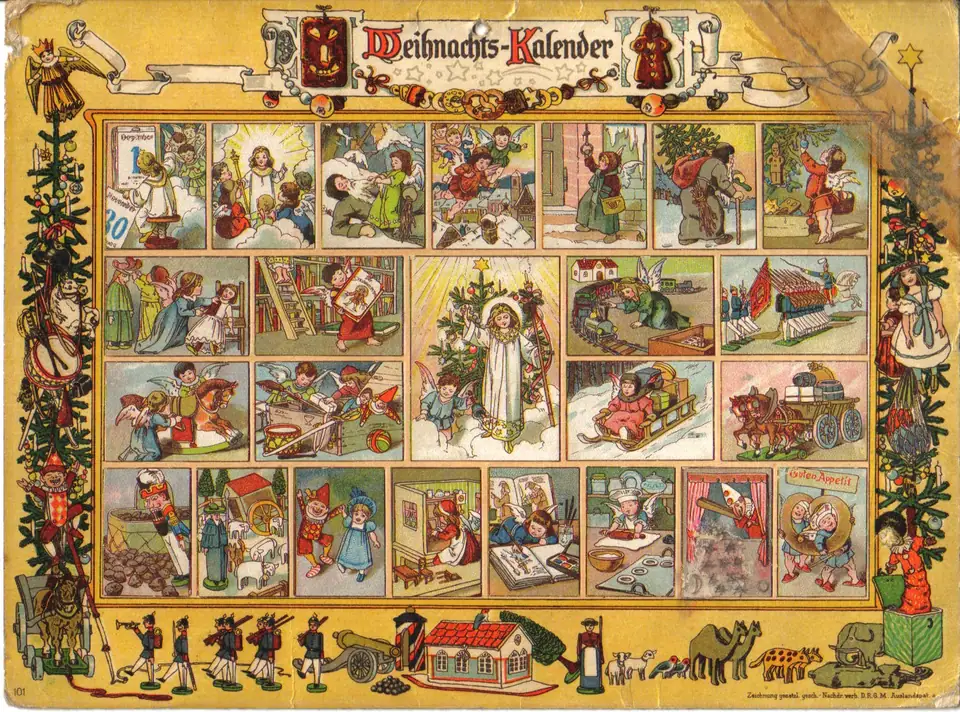
The Advent calendar began in 19th century Germany, where Protestant families counted the days to Christmas with chalk marks, candles and pictures. Munich publisher Gerhard Lang is credited with the first printed calendars in the early 1900s. Doors followed around 1920, chocolate around 1926, and after World War II the custom spread to Britain and the United States.
Advent calendar history at a glance
| When | What happened |
|---|---|
| 19th century | German Protestant families count down with chalk marks, candles, straws in a crib or daily pictures |
| 1851 | A children’s book by Elise Averdieck describes a new picture hung on the wall each evening until all 24 are up |
| 1902 | “Weihnachtsuhr für Kinder,” a printed Christmas clock, probably the oldest printed countdown |
| 1903 or 1908 | Gerhard Lang’s first printed calendar, “Im Lande des Christkinds” |
| From about 1920 | Calendars with doors to open spread |
| About 1926 | Lang’s “Die Christrose” edition holds 20 Stollwerck chocolates |
| World War II | Paper rationing and a Nazi ban on picture calendars |
| December 1945 | Richard Sellmer in Stuttgart receives one of the first postwar printing permits |
| December 1953 | Newsweek photo of Eisenhower’s grandchildren with a calendar |
| 1971 | Cadbury makes its first chocolate Advent calendar |
How did people count down to Christmas before printed calendars?
With whatever was at hand. Britannica describes German Protestants in the 19th century lighting a candle, placing a straw in a Nativity crib, marking walls or doors with chalk, or hanging a devotional image each day. Children could wipe away one chalk line each morning.
One of the earliest written descriptions comes from an 1851 children’s book by Elise Averdieck. The Deutsches Weihnachtsmuseum, a Christmas museum in Rothenburg ob der Tauber, quotes it: a mother tells the Christmas story each evening, a new picture goes up on the wallpaper, and when all 24 pictures hang there, Christmas has come.
The museum also notes that early calendars were called “Nikolauskalender,” because they were given on St. Nicholas Day, December 6. Later they started on December 1, and the name “Adventskalender” took hold.
Who made the first printed Advent calendar?
The first printed countdown was probably a clock, not a calendar. The Deutsches Weihnachtsmuseum identifies the “Weihnachtsuhr für Kinder” (Christmas clock for children) of 1902, with a turning brass hand and a dial starting at 13.
But the person usually called the inventor is Gerhard Lang (1881 to 1974), the son of a Swabian pastor, who settled in Munich and became a publisher. When he was a boy, his mother sewed 24 small pastries onto a piece of cardboard, and he was allowed to eat one each day before Christmas. The German Wikipedia names the pastries as Wibele, a small meringue-style pastry from the Hohenlohe region.
Lang turned the idea into print. His first calendar, “Im Lande des Christkinds” (In the Land of the Christ Child), was illustrated by Ernst Kepler. It had no windows. It came as two sheets: one printed with 24 short poems in boxes, and one with 24 matching pictures to cut out and glue on.
The date depends on the source. The German Wikipedia article on Lang says he had the idea in 1903, and Sellmer notes that the Lower Austrian State Museum also gives 1903. The Deutsches Weihnachtsmuseum dates the first commercially sold edition to 1908, after a preliminary project in 1904, and Sellmer’s company history also gives 1908. Both dates are in wide use.
When did Advent calendars get doors?
Around 1920. Sellmer’s history says the first calendars with little doors to open appeared from around 1920, and the German Wikipedia credits Lang with calendars with doors from 1920. Britannica credits him with adding small doors “in the 1920s,” with pictures behind them.
The 1920s were a boom time. The Deutsches Weihnachtsmuseum says demand rose steadily from 1920 after World War I had stalled sales, and publishers began selling calendars in several sizes and price levels.
When did chocolate first appear in Advent calendars?
Earlier than many popular accounts say.
- About 1926: the first. The Deutsches Weihnachtsmuseum records that around 1926 Lang released an edition of his calendar “Die Christrose” holding 20 pieces of chocolate from the Stollwerck company. The Schwäbische Zeitung, a regional German newspaper, also credits Lang with the first sweet-filled calendar, “Die Christrose,” in the mid-1920s.
- The 1950s and 1960s: more chocolate calendars appear. Britannica says chocolate behind the doors “apparently began in the 1950s,” and British historian Martin Johnes writes that chocolate calendars were being made in the UK in the 1950s and 1960s but did not seem to catch on.
- 1971: Cadbury. Johnes, author of Christmas and the British: A Modern History, writes that Cadbury made its first chocolate calendar in 1971 and did not put them into continuous production until 1993. NPR reports the same 1971 date.
In Britain, Johnes notes, the standard calendar through the 1980s was a cardboard sheet of festive pictures with a Nativity scene behind the last door. Chocolate calendars only became the norm there in the 1990s.
What happened to Advent calendars during World War II?
Production nearly stopped. Britannica says printing paused during the war because paper was rationed and the Nazi Party banned calendars with images. The Deutsches Weihnachtsmuseum adds that the Nazi era renamed them “Vorweihnachtskalender” (pre-Christmas calendars) and replaced traditional and religious images with Nazi symbols and ideology.
Lang’s own business did not survive. The German Wikipedia says paper shortages after the war began, competition and price pressure forced him to stop printing calendars and close the firm in 1940. Sellmer’s history says he had published about 30 designs by then.
How did the Advent calendar reach America?
Through a Stuttgart printer and returning soldiers.
In December 1945, the American occupation authorities gave the Richard Sellmer Verlag in Stuttgart one of the first permits to print Advent calendars, according to the German Wikipedia. In 1946 Sellmer produced “Die kleine Stadt” (The Little Town), designed by Elisabeth Lörcher. The company still sells it and still prints its calendars in Stuttgart.
Britannica says returning service members carried calendars back to the United States. National Geographic reports that Sellmer used his American contacts to introduce them there.
Then came a photo. In 1953, Newsweek published a picture of President Dwight D. Eisenhower’s grandchildren with an Advent calendar, which gave the calendars a boost in popularity, according to Vox. Wikipedia dates the Newsweek picture to December 1953. A 1953 photo published by National Geographic shows the three grandchildren joining an appeal for sales of calendars imported from Germany by the National Epilepsy League.
Why do Advent calendars start on December 1?
Advent itself starts on the Sunday nearest November 30, so its length changes every year. Britannica notes that most commercial calendars skip that problem and begin on December 1. Johnes points out a second reason: a fixed December 1 start let early commercial calendars be reused each year.
That fixed count is also what makes today’s refillable wooden and fabric calendars work year after year. Our guide on when to start an Advent calendar covers December 1 versus Advent Sunday in more detail.
Reusable wooden Advent calendars on eBay
Shop the range
Browse current wooden advent calendars on eBay, new condition only.
Shop wooden advent calendarsOpens eBay in a new tab. Check condition, seller feedback and returns on the listing.
From chocolate to beauty boxes
Britannica describes the 21st century shift: companies began selling sample and full-size products in calendar form, and adults now count down with beauty products, gourmet food, jewelry and more. NPR reported in 2022 that the UK department store Selfridges offered 128 different Advent calendars that year, more than double the year before, citing Reuters.
To see how far the idea has traveled from chalk marks on a door, browse our best Advent calendars, or compare modern chocolate options in tea, coffee and chocolate Advent calendars. Families refilling their own can find ideas in our Advent calendar filler ideas.
Frequently asked questions
Who invented the Advent calendar?
No single person. German Protestant families counted down to Christmas with chalk marks, candles and pictures in the 19th century. Munich publisher Gerhard Lang is generally credited with the first printed, commercially sold calendar, inspired by a homemade one his mother made.
When was the first chocolate Advent calendar made?
The Deutsches Weihnachtsmuseum dates the first to around 1926, when Gerhard Lang released an edition of his calendar "Die Christrose" holding 20 pieces of Stollwerck chocolate. Chocolate calendars became common much later; in Britain, Cadbury made its first in 1971.
Why do Advent calendars start on December 1?
Advent begins on a different Sunday each year, so its length changes. Early commercial calendars counted from December 1 instead, which let the same design be reused every year.
How did Advent calendars come to America?
After World War II, returning service members brought German calendars home. Interest grew after Newsweek published a photo of President Eisenhower's grandchildren with an Advent calendar in December 1953.
Sources
- Advent calendarEncyclopaedia Britannica
- Adventskalender (exhibition page, archived November 29, 2022)Deutsches Weihnachtsmuseum, Rothenburg ob der Tauber
- Gerhard Lang (Verleger)Wikipedia (German)
- AdventskalenderWikipedia (German)
- Advent calendarWikipedia
- The history of the Advent calendarRichard Sellmer Verlag
- Advent calendars, explained: Where they came from and why they're everywhere nowNPR
- A brief history of Advent calendars in the UKMartin Johnes, Swansea University historian
- What is Advent and why do we celebrate with calendars?National Geographic
- What is Advent? How and why the season of anticipation is celebratedVox
- Tür 23: Gerhard Lang und der Adventskalender, eine echt schwäbische IdeeSchwäbische Zeitung
Part of our guide to Best Advent Calendars of 2026: Fun, Useful and Unusual Picks.